



December 2025 closed a year that confused almost everyone. Bitcoin ended down about 6% on December 31st, while the S&P 500 posted its third consecutive year of double-digit gains.
Coinbase called it perfectly: “Structural progress collided with stagnant price action.”
Here’s what happened and what it means.
Institutions Bought Through Negative Returns
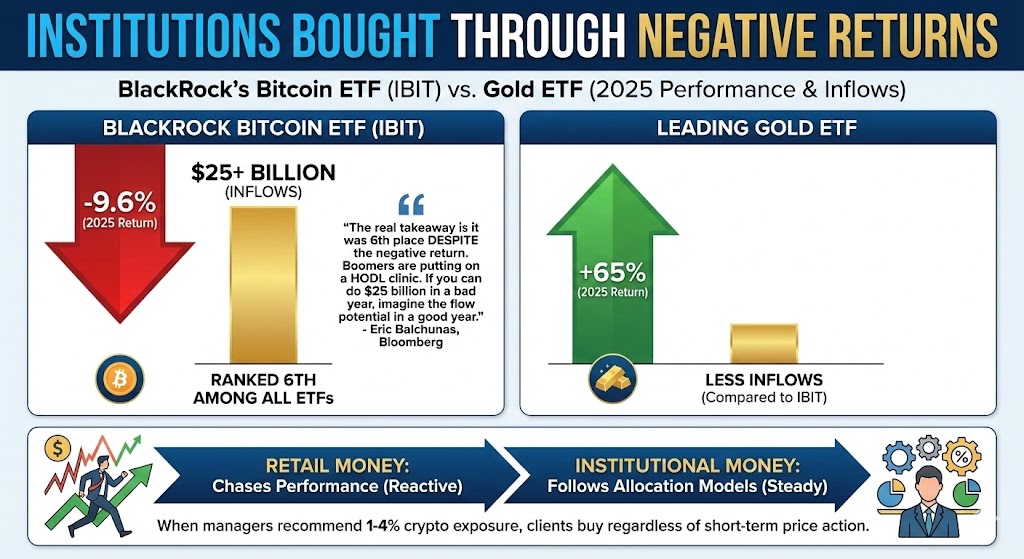
BlackRock’s Bitcoin ETF ranked sixth among all ETFs for inflows despite losing 9.6% in 2025. The fund pulled in more than $25 billion, beating the leading gold ETF, which gained 65%. Bloomberg’s Eric Balchunas wrote: “The real takeaway is (Bitcoin) was 6th place despite the negative return. Boomers are putting on a HODL clinic. If you can do $25 billion in a bad year, imagine the flow potential in a good year.”
Retail money chases performance while institutional money follows allocation models. When major asset managers recommend 1-4% crypto exposure, their clients buy regardless of short-term price action.
Corporations Kept Accumulating
Digital Asset Treasury companies added 42,000 Bitcoin from mid-November to mid-December, making this the largest corporate accumulation since July. While retail traders were panicking about price drops, corporate treasurers were buying.
Michael Saylor’s Strategy, the largest corporate holder, purchased 8,178 Bitcoin worth $835 million and now holds 671,268 Bitcoin valued at $58.9 billion on its balance sheet.
The momentum isn’t limited to the United States. Japanese company Metaplanet’s shareholders voted to raise money for more Bitcoin purchases, and Japan now has 13 publicly listed companies holding Bitcoin as a treasury asset. This represents a fundamental shift in how corporations think about their balance sheets.
These companies are not day trading for quick gains or speculating on short-term price movements. They’re converting cash reserves into long-term treasury assets, treating Bitcoin the same way previous generations of CFOs treated gold, bonds, or foreign currency reserves. When publicly traded companies start viewing Bitcoin as a strategic asset rather than a speculative gamble, that signals a permanent change in the financial landscape.
Texas Made History
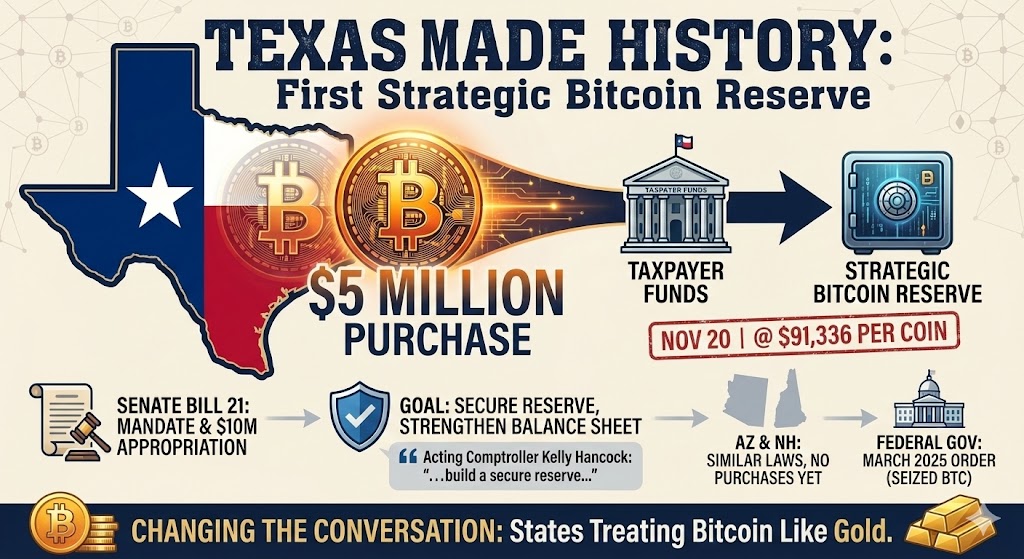
Texas bought $5 million in Bitcoin on November 20 at $91,336 per coin, becoming the first US state to fund a strategic Bitcoin reserve with taxpayer money. Acting Comptroller Kelly Hancock said: “The Texas Legislature passed a bold mandate to create the nation’s first Strategic Bitcoin Reserve. Our goal is simple: build a secure reserve that strengthens the state’s balance sheet.”
Senate Bill 21 created the reserve and appropriated $10 million for the program. Arizona and New Hampshire passed similar laws; however, neither state has made purchases yet, making Texas the first mover. This follows the federal government’s March 2025 executive order establishing a Strategic Bitcoin Reserve for roughly 198,000 Bitcoin held.
When states start treating Bitcoin like gold reserves, the conversation fundamentally changes. This isn’t about speculation or making quick returns. It’s about diversifying state treasury holdings and protecting against dollar devaluation over the long term.
Bitcoin’s Network Strength Signal
Bitcoin’s network processing power dropped 4% in December, marking the sharpest decline since April 2024. On the surface, this might sound negative, but history tells a different story.
VanEck analyzed every similar drop over the past decade and found a clear pattern. When Bitcoin’s network power decreases like this, the six months that follow typically see 72% returns compared to only 48% when network power stays flat or grows. The December drop improved the historical odds for strong six-month gains by a significant margin.
Think of it like a coiled spring. When the network compresses, it often rebounds harder. This isn’t a guarantee of future performance, but it’s a pattern worth noting when the data goes back more than ten years.
The Four-Year Cycle Debate
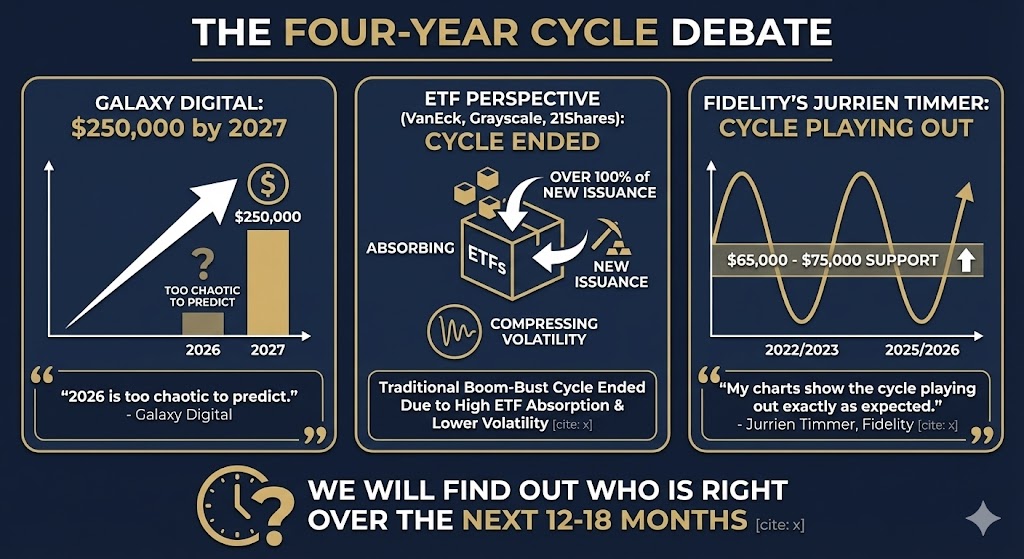
Galaxy Digital projects Bitcoin at $250,000 by 2027 while calling 2026 “too chaotic to predict.” VanEck, Grayscale, and 21Shares argue the traditional boom-bust cycle ended because ETFs now absorb over 100% of new issuance, and volatility is compressing.
Fidelity’s Jurrien Timmer disagrees, saying his charts show the cycle playing out exactly as expected with support in the $65,000-$75,000 range.
We will find out who is right over the next 12-18 months. Either way, the infrastructure being built now will matter more than whatever short-term price action we see in 2026.
Faith-Based Investing Works
Islamic finance now represents a $4 trillion industry where ESG funds have outperformed the S&P 500 over five years.
Environmental stewardship is embedded in the Quran, creating investment frameworks that screen for sustainability while delivering superior returns. At BostonTrading, we launched the world’s first Halal, Kosher, and Sanata Dharma crypto funds.
Ethical investing does not require sacrificing returns. In many cases, the discipline of screening out questionable projects produces better portfolios because it forces you to focus on quality and fundamentals rather than hype and speculation.
Silver Hits All-Time High
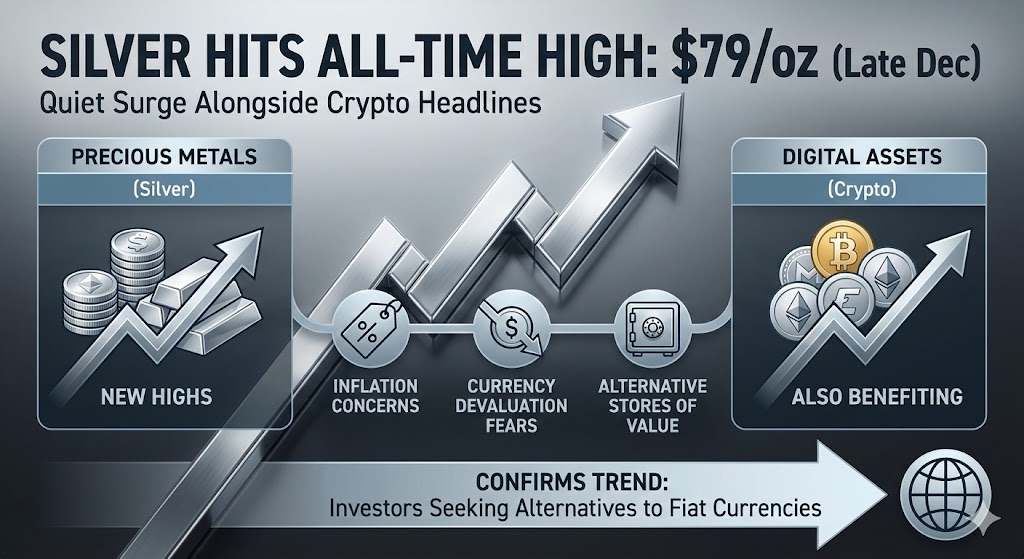
While crypto grabbed headlines, silver quietly reached new all-time highs in late December, touching US$79 per ounce. This matters for crypto investors because both assets benefit from similar forces: inflation concerns, currency devaluation fears, and the search for stores of value outside traditional systems. When precious metals surge alongside digital assets, it confirms the broader trend of investors seeking alternatives to fiat currencies.
BostonTrading bought silver a few years ago in 2019, and investors who followed our suggestions have significantly benefited by almost 200%.
Bitcoin’s Rare U.S. Trading Gains
After months of selling pressure during American trading hours, Bitcoin rose above $89,000 during U.S. sessions on December 30, marking a potential shift in market dynamics.
For most of late 2025, crypto prices typically dropped when U.S. markets opened, creating a pattern where American investors appeared to be net sellers while other regions accumulated. This reversal could signal changing sentiment heading into 2026, with American investors showing renewed appetite rather than continued selling pressure.
Fund Updates
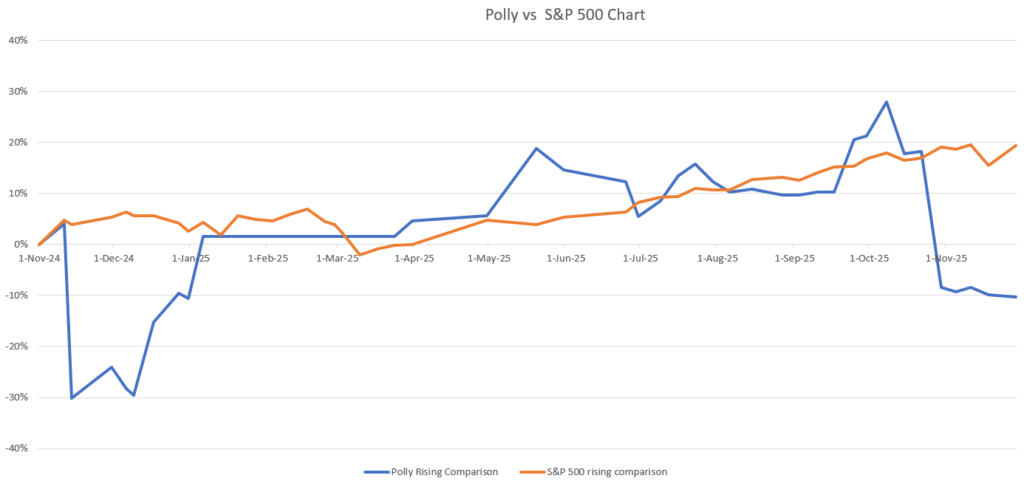
Polly vs S&P 500: POLLYcoin AI finished at $107.10. Our capital stability fund experienced a setback in late October but has since recovered. This fund is designed for investors with 1-3-year horizons who want crypto exposure with lower volatility than pure Bitcoin.
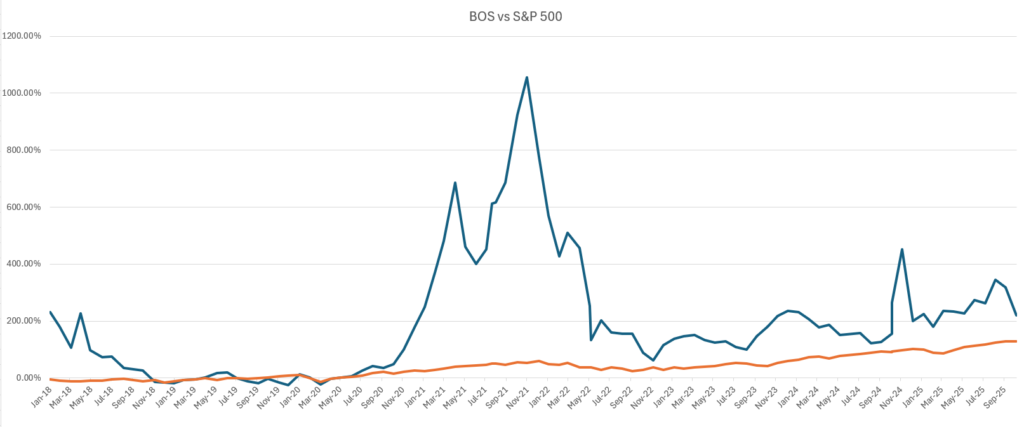
BOS vs S&P 500: The Bostoncoin fund hit $63.36. The chart shows we’re still significantly ahead of the S&P 500 since our launch ten years ago, even with the pullback from October highs. Long-term performance is what matters, and over five to seven years, the numbers speak for themselves.
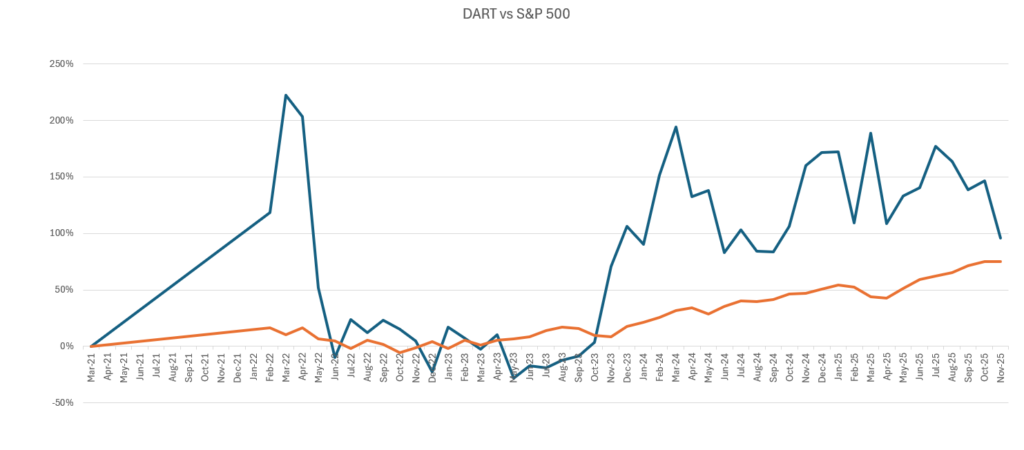
DART vs S&P 500: DARTcoin closed at $129.04. This fund carries higher volatility but offers higher growth potential. The chart shows the swings that come with aggressive crypto exposure, but the long-term trend still beat traditional markets for investors who can handle the ride.
What This Means
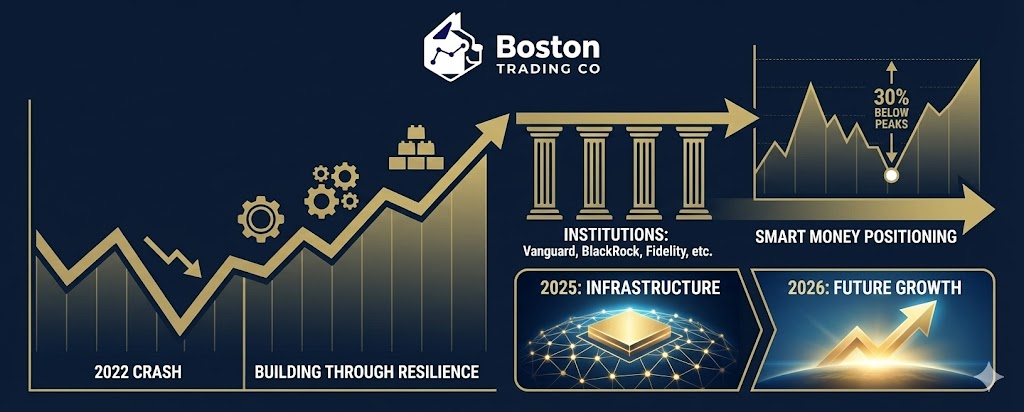
We have watched this space for ten years. We got in early when crypto was still considered fringe technology. We stayed through the brutal 2022 crash when everyone declared the space dead, and we kept building infrastructure when prices were at their lowest.
The big Wall Street institutions are now coming into our playground: Vanguard, BlackRock, Fidelity, Bank of America, Morgan Stanley, Texas, the federal government, and Japan’s public companies. They are all buying or allocating capital to crypto while prices sit 30% below October peaks. That’s not a coincidence, that’s conviction.
The smart money is not waiting for perfect conditions or confirmation that the bottom is in. The big players are positioning while others hesitate, accumulating while retail investors panic, and building positions while prices are quiet.
The year 2025 was tough on prices; however, it was exceptional for infrastructure development, regulatory clarity, and institutional adoption. The year 2026 will show which one mattered more. We think the answer may be already clear.
Happy New Year,
JB
We’d Love Your Feedback
If this update helped you stay informed:
✓ Leave us a review, and we’ll donate to your chosen charity
✓ Please forward this newsletter to a friend who needs some crypto clarity
✓ Share on X, LinkedIn, or Facebook with hashtag #BostonCoin
Are you ready to explore the Boston fund? Book a Discovery Call
Send a screenshot of your TrustPilot review to support@bostontrading.co with your postal address, and we’ll send you a gift from the team.

